

 BoatChat
 BoatChat
 BoatChat
 BoatChat
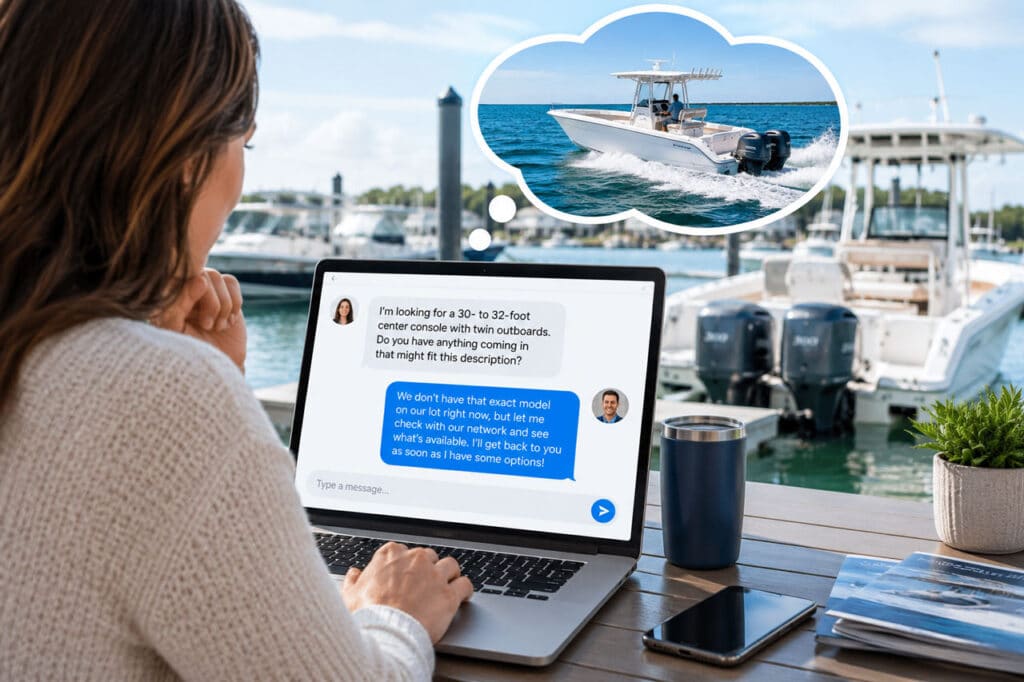 Boat dealerships naturally focus their websites on the inventory sitting on the lot. That makes sense. New arrivals, available models, special pricing, and featured boats deserve attention.
But there’s another type of inventory that can generate valuable sales opportunities:
The boat a customer can’t find on your website.
A shopper may arrive looking for a specific size, layout, engine configuration, or price range. If nothing matches, the conventional approach is simple:
The customer leaves. But what if the dealership could capture that demand instead?
Not Having It Doesn’t Mean You Can’t Sell It
Boat buyers don’t always know exactly which model they want.
They may know they want:
- A larger center console
- A family-friendly cruiser
- A fishing boat under a certain budget
- A boat with twin engines
- A specific length
- Something suitable for offshore use
- A newer boat than the one they currently own
If the website doesn’t show exactly what they’re looking for, they may assume the dealership can’t help. That’s where a conversation can change everything.
The “Wish List” Lead
Imagine a visitor looking through your inventory. They find several boats they like, but none quite fit.
Instead of leaving, they start a BoatChat conversation:
“I’m looking for a 28- to 32-foot center console with twin outboards. Do you have anything coming in?”
That’s a completely different type of lead. The customer isn’t asking about a boat you already have. They’re telling you what they want to buy. That information has value.
Capture Demand Before It Disappears
Inventory changes constantly. A boat that isn’t available today may arrive next week. A trade-in may be coming. A customer may be preparing to sell or trade a boat that matches another shopper’s request. A dealership may also be able to locate a particular model through its network or other inventory channels. Without a conversation, none of that matters. The buyer has already moved on.
BoatChat gives the dealership an opportunity to capture the request while the buyer is actively shopping.
Turn “No” Into “Let Us Look”
There is a big difference between saying:
“We don’t have that boat.”
and:
“We don’t have that exact boat listed right now, but let us see what may be available.”
The second response keeps the relationship alive. It also gives the dealership useful information about what customers are actually looking for. Over time, those conversations can reveal patterns in local demand.
Your Chat Transcripts Can Become an Inventory Signal
Customer conversations contain information that traditional website analytics don’t always reveal.
For example, a dealership might discover that visitors repeatedly ask for:
- 30-foot fishing boats
- Used boats under a particular price
- Specific engine packages
- Family-oriented layouts
- Certain manufacturers
- Larger boats suitable for offshore use
That information can help sales and inventory teams understand what shoppers want—even when those boats aren’t currently sitting on the lot. In other words, the conversations themselves can become a source of market intelligence.
Give Future Inventory a Head Start
Suppose a customer says:
“I’m not ready to buy today, but I’m looking for something around 30 feet. If you get one in, I’d like to know.”
That shouldn’t necessarily be treated as a dead lead. It’s a future opportunity.
The dealership now knows:
- What the customer wants
- What size they’re considering
- What type of boating they’re doing
- What inventory could bring them back
When the right boat eventually arrives, the dealership has a reason to reconnect.
Capture Trade-In Opportunities Too
There’s another side to this strategy. Sometimes the boat a shopper wants is already owned by someone else. A current customer may have exactly the type of boat another prospect is searching for—and may also be approaching the point where they’re ready to upgrade.
That creates a potential chain reaction:
Customer wants a different boat → dealership identifies the demand → dealership finds a potential trade → customer upgrades → another buyer gets the boat they’re looking for.
A simple website conversation can be the first link in that chain.
Don’t Let “Not in Stock” End the Conversation
Inventory is temporary. Customer relationships don’t have to be.
A dealership’s website shouldn’t only answer the question:
“What do you have?”
It should also make it easy for customers to say:
“Here’s what I’m looking for.”
That’s a much bigger opportunity.
BoatChat Helps Dealers Capture the Boat They Don’t Have
BoatChat gives visitors a simple way to tell the dealership what they’re searching for—even when the perfect boat isn’t currently listed. That means fewer conversations ending with a dead end. More insight into customer demand. More opportunities to match buyers with future inventory. And potentially, more deals created from boats that weren’t even on the website when the conversation began.
Your Next Sale May Start With a Boat You Don’t Have Yet
The perfect boat for your next customer might not be sitting on your lot today. But the customer looking for it might already be on your website. Don’t let that opportunity leave simply because the right boat isn’t in inventory yet.